
By Samuel Peckett
Today, virtual reality technology is far more common than it was even just five years ago. Two years after being bought by Facebook for $2 billion in 2014, the Oculus Rift VR headset hit the market, and has since received an upgrade, with the Oculus Rift S being released in 2019.
The Rift has finally allowed VR technology to be sold as a mass consumer product, but getting to this point has taken a long time.
Alisdair Swenson, Research Associate with Manchester Metropolitan University’s Creative AR & VR Hub, explained that this isn’t the first time VR has tried to make a breakthrough.
“There have been attempts to bring VR out before now in the 1980s, and things like the Sensorama back in the 1960s tried to do it by basically strapping a huge TV to your face.”
In the 1990s, technological advances were making VR more viable, but it still cost “tens of thousands of pounds”, making it infeasible as a mass product.
“What’s really happened in the last few years is that mobile technology has brought down the price of the screens and the sensors, all the things you need in order to make a VR headset work. These things have come down in cost and are now available to the general public.”
Not only is VR now more readily available to the general public, it’s also getting safer.
“You can walk in a space of 30 square metres and it takes into account safety, so if you’re about to walk into something it shows you the real view of the world, so you can see.”
While Oculus have made it clear that the Rift is primarily a gaming tool, Alisdair believes the scene is set for VR to dive into a variety of industries, such as journalism.
“I think [Oculus Rift] got massive traction and interest from many people, mainly games players. But now it’s coming out that it’s not games but it’s experiences that can come from these immersive technologies, and that’s what I think we’re going to see more and more of.”
While the Rift began with gaming in mind, a huge selection of apps are now available, including a variety of apps based around storytelling and narrative. These apps are available for use on the Rift, alongside competitors like the HTC Vive and Open-Source Virtual Reality (OSVR).
The difficulty of creating VR content
Although Alisdair is predicting we will see more and more from these technologies, he explained that creating VR content is tough.
“There are methods of capturing, but making interactive content or 3D content where you need to make a model or 3D scan, that can be very expensive. You need the in-house expertise to pull it off in a timely fashion.”
As a result, the journalism industry, which has been perceived to be on cusp on a VR boom for years now, is still waiting for that boom to arrive. Speaking to journalism.co.uk last year, Sarah Redohl, Editor for Immersive Shooter, said: “20XX is now the year of VR, because I am not going to say that 2018 will be the year of VR – we said that with 2015, 2016 and 2017, but I think we are in the age of VR.”
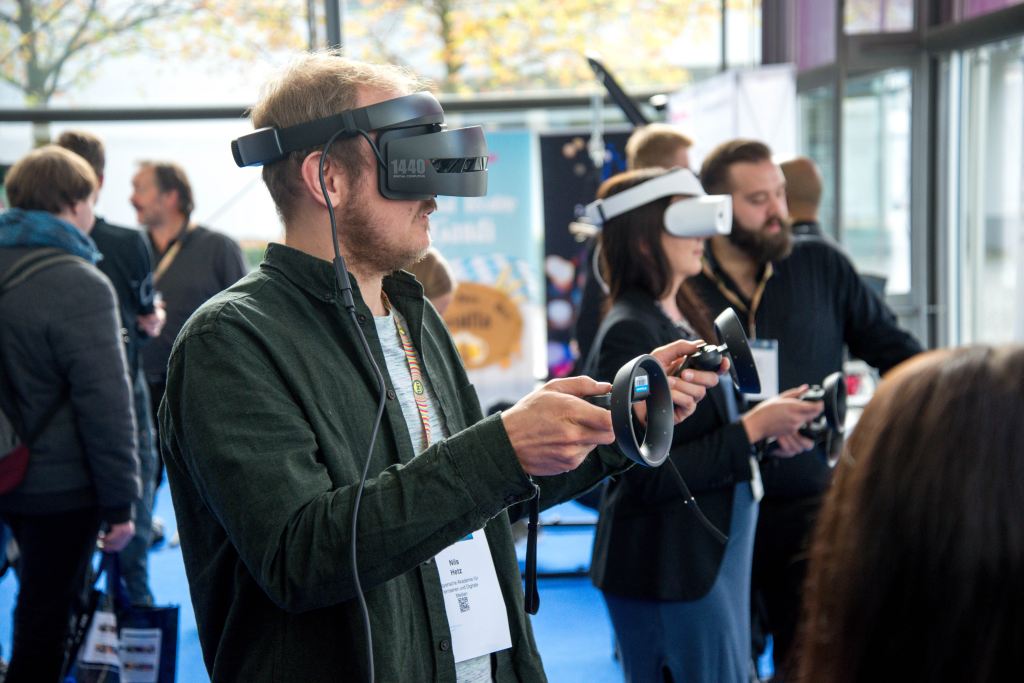
While those in the industry remain hopeful it will take off, some reports suggest that sales of VR headsets are beginning to plateau or even decline, as Augmented Reality (AR), the idea of using technology to superimpose imagery on the real world, becomes a new focus.
While Oculus did bring VR to a mass market, the price point may have been too high for it to be widely adopted – making it hard to be used as a viable piece of technology for telling news stories on a large scale. That, coupled with the cost and time of developing virtual worlds, means that VR hasn’t yet gone mainstream in journalism – the time and cost just doesn’t reach a large enough audience.
The growth of AR
Possibly detrimental to VR’s growth into mainstream journalism is the rise of AR, which Alisdair says has “well overtaken VR” in the immersive industry, because we have the required technology, such as cameras on smartphones, “in our pockets”.
With Amazon investing in AR glasses, alongside rumours that Apple are doing the same and are possibly planning for AR glasses to replace the iPhone, it could be that AR ends up being adopted on a large scale instead of VR.
Speaking to The Independent in 2017, Apple CEO Tim Cook said: “The smartphone is for everyone, we don’t have to think the iPhone is about a certain demographic, or country or vertical market: it’s for everyone. I think AR is that big, it’s huge.”
If AR does get that big, it’s possible that VR would have to step aside for the new immersive technology of choice, before it ever gets the chance to hit the journalism mainstream.
 Journo Tech